


“Emma talks too much and is a distraction to herself and others.”
This was a phrase that was all too familiar to current St. Luke’s senior Emma Ryan during her elementary school years. Year after year, Emma’s report cards, parent-teacher conferences, and phone calls home all echoed this sentiment. Teachers tried assigning extra work, but she saw right through the “futile attempt to keep me busy, keep me quiet.” On multiple occasions, they tried moving her seat, but that just meant Emma had a new person to talk to.
Despite how it may have appeared, Emma was not uninterested in learning; she was simply drawn to people. “Each person was a puzzle to me,” she later reflected. “I wanted to understand their interests and live vicariously through their stories while sharing mine with them.”
Being at a large and overcrowded public middle school only intensified these issues. In elementary school, teachers would “hold your hand,” but in middle school, she “could just talk to my friends at the back of the classroom” while “not doing a lot of work.” Emma described learning during this period as something that felt “very transactional,” seeing it as something to complete rather than engage and grow from. She continued to receive feedback about what she was doing wrong, but this time, teachers did not even try to implement solutions to the problem.
It was clear to Emma’s parents that she was struggling to find success in her current environment. For years, they floated the idea of boarding school, but Emma pushed back, wanting to stay close to her friends. Finally, they compromised on St. Luke’s.
When Emma arrived on The Hilltop in eighth grade, she was not immediately enthusiastic. Her nerves led her to try to seek comfort in the bad habits that led to her making the change in the first place. “I planned to start the year by finding a spot in the back of the classroom,” she said, assuming that she would go unnoticed. But to Emma’s surprise, when she stepped into her first classroom, she saw the round Harkness tables. “You can’t really hide,” Emma said. The physical and social space to disengage was eliminated.
The round table wasn’t the only change Emma had to get used to. The classes were smaller, making it more difficult for her to lose focus. She was now more engaged with the material and the learning processes, constantly participating and enjoying the work.
Emma recalls one specific turning point where, after receiving some blunt feedback on a paper from Mr. Wieland, instead of “shutting down” as she might have in the past, she sought support. “I would go after class for extra help with him to work on my writing,” she said. Emma was no longer a passive student just looking to get by. She was now an active learning, looking for ways to improve and develop her skills.
However, that spirit to unpack puzzles through dialogue did not die. St. Luke’s Community Goals for Learning (CGL) discussions immediately resonated with her. From her first conversation on gun control, “I loved it.” She “had found exactly what I had been yearning for, spirited conversation where everyone’s voice was valued.” The trait that had long gotten her into trouble could now be harnessed as a tool for learning.
As Emma has moved into Upper School, she stepped into the role of CGL facilitator. Through this role, she learned to manage strong personalities and even stronger viewpoints. In one instance, she was put with a paired advisory filled with outspoken boys who often dominated the conversation. “I found a way to steer the conversation to a place where everyone in the room had a space to speak,” Emma said.
Her growth as a communicator, leader, and learner has been evident to those around her. Emma’s advisor and faculty advisor to Midnight Run, a club Emma leads, Ms. Yochem has seen firsthand how Emma has become a confident and reliable leader. “She’s still a talker,” Yochem said, “but when she speaks, students listen.” This was especially clear to Yochem at the most recent Midnight Run, where Emma organized clothing distribution on the streets of New York City. “She has stepped it up significantly in her ability to communicate,” Yochem noted, and “she’s always incredibly attentive to the things that have to happen.”
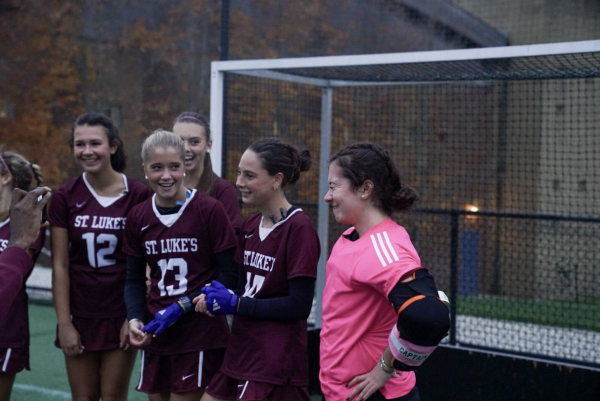
On the athletic side, Emma’s leadership emerged just as strongly. Girls Varsity Tennis coach Ms. Ehlers said Emma, as a captain of the team, is “humble and approachable” and is able to communicate effectively with the group, motivating them to reach their goals. Her field hockey co-captain Sheridan Whitacre echoed that sentiment, noting that Emma “always brings out everyone’s best side.”
Ryan is the first, but definitely not the last, person to admit that she is still chatty. Yet, what once made her a distraction to herself and others is now her defining strength; her ability to spark conversation has built communities and ensured voices are heard and elevated.