


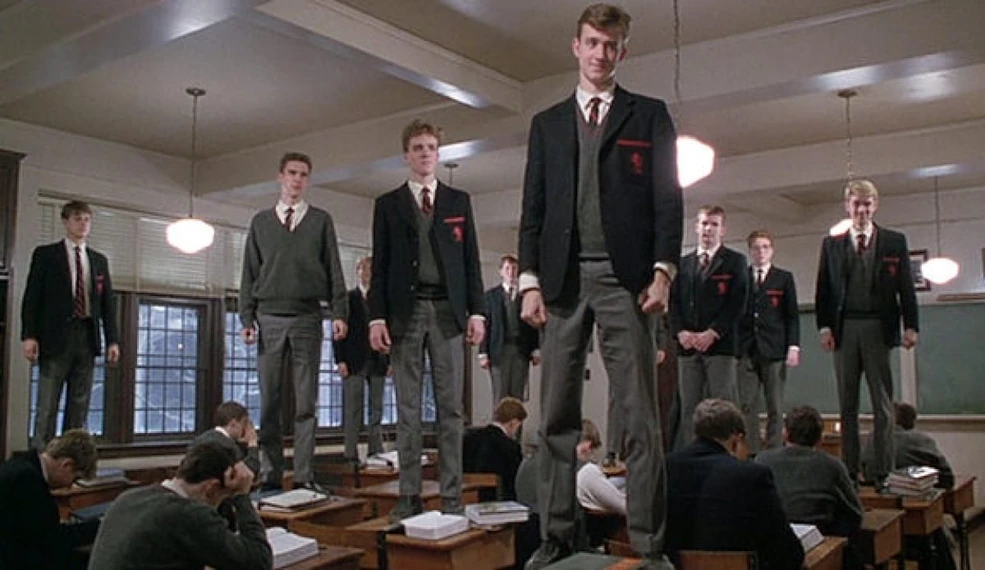
Set in 1959 at the strict, all-boys Welton Academy, Dead Poets Society (1989) tells the story of a group of students whose highly structured and rigid lives are transformed by their new English teacher, John Keating. At Welton Academy, students are expected to follow a clear and disciplined path toward success. However, Keating (played by Robin Williams) introduces a completely different philosophy; one centered on the core idea of “Carpe Diem,” Latin for “seize the day”.
The director of this movie, Peter Weir, is also well-known for directing the 3-time Golden Globe-winning film The Truman Show (1998). In this film, viewers follow Jim Carrey as “Truman Burbank” as he navigates his seemingly normal and serene life. However, Truman has been unknowingly trapped in a regulated world his whole life. Compared to this film, Dead Poets Society is a much milder and direct watch, but it still carries Weir’s signature focus on personal awakening. Instead of physical isolation like Truman faces, students at Welton Academy experience institutional confinement and an inability to express themselves.
From the beginning, the film establishes a contrast between control and freedom. Welton Academy is suffocating for the boys because of its strict rules and high expectations from both the school and parents. A majority of the boys are not pursuing their own dreams, but rather the ambitions of their parents. Many audience members have no doubt felt in their lives, which is why the film becomes all the more powerful.
The heart of the film is clearly Robin Williams’ performance as Keating. Unlike traditional teachers at Welton, he encourages students to stand on their desks, challenge authority, and see the world from different perspectives. His teaching style is unconventional, but it never feels unrealistic or forced. It actually feels more genuine, like Keating truly wants his students to discover who they are beyond grades and expectations. Williams brings wisdom, energy, and warmth to the table, making the movie all the more inspiring. This was not the only time Williams would play a mentor. In the 1997 film “Good Will Hunting,” Williams would play a “crazy” therapist who used bizarre methods to help his patients. This film is similar in that it addresses sensitive, hard-to-talk-about topics that affect us all.
One of the film’s strongest aspects is how it portrays the students themselves. Each character feels distinct with their own struggles, personalities, and growth. The protagonist, Todd Anderson, specifically struggles with living in the shadow of his high-achieving older brother. This internal conflict becomes the starting point for his transformation under Keating’s guidance. As each student begins to embrace Keating’s ideas, they revive the secret “Dead Poets Society,” a group of students who sneak off campus to read poetry and express themselves freely. These scenes, set in a quiet cave away from the pressures of school, illustrate a sense of escape to discover themselves. The film authentically captures the excitement and vulnerability of adolescence.
This movie stood out to me because of its tone. This movie was focused on a serious, reflective approach. The pacing is steady, and with a run time of 2 hours and 8 minutes, it gives time throughout to give the audience a chance to understand the pressures each student faces. This is why I think this is a good movie to watch at all ages (except young children). Not only because it is one of the most iconic movies of the 20th century, but also because the themes can apply to a watcher at any point in their life. Fear of failure and the struggle to form self-identity are still relevant topics today.
At the same time, the film avoids being overly simplistic. It doesn’t suggest that rejecting authority is consequence-free. Rather, it presents a sensible view of what happens when individuals try to challenge deeply rooted systems. I don’t think this story became less impactful without the “perfect” ending.
Dead Poets Society is simply a film about finding one’s voice. It encourages viewers to think independently, take risks, and pursue what truly matters to them. This is one of the few movies I watched that changed the way I look at life. It stays with you long after watching because of the powerful performances and themes.
In the end, the movie was so successful in the eyes of the general public because of how deeply it connected with the audience. Although the acting is impeccable and the plot twist will leave your mouth agape, the lesson is far more essential: the courage it takes to be different. For anyone who has ever struggled with their own path, this movie is a paramount watch. I would rate this movie in my top five just because it left me so hopeful after a gut wrenching ending.