

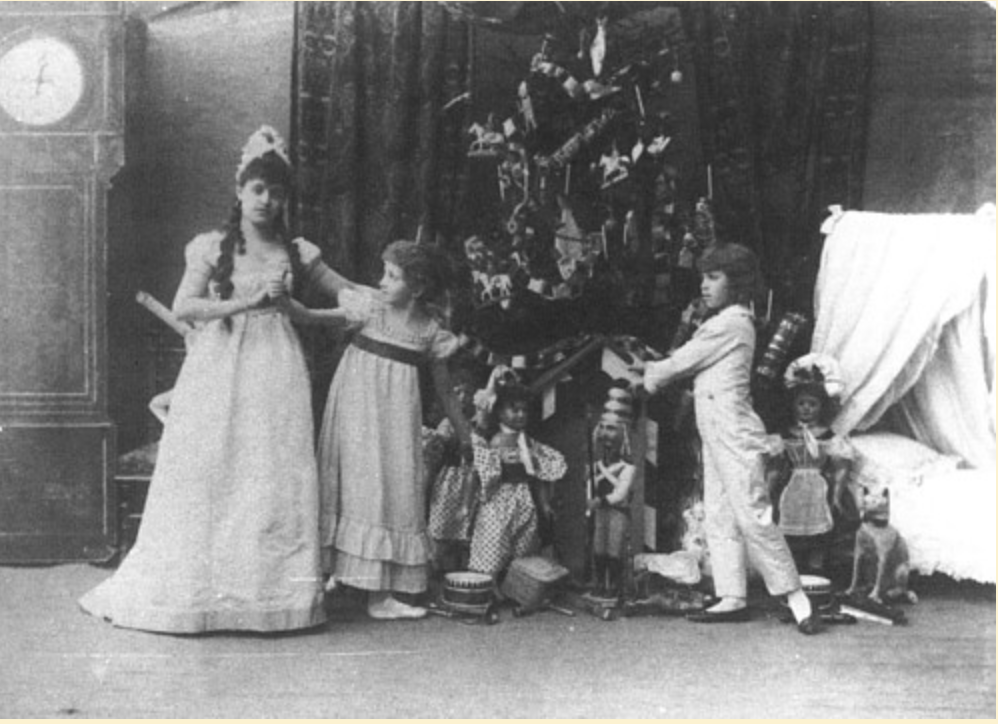
On December 17th, 1892 in St. Petersburg, Russia, composer Pyotr Ilyich Tchaikovsky changed the face of ballet forever. It was on this day that the inaugural performance of The Nutcracker Ballet took the stage. Through the years, the ballet once referred to by Tchaikovsky himself as “rather boring” transformed into a holiday classic that has become the most frequently performed ballet of all time (Schwarm and Poznansky). Following its Russian debut, the piece crossed the Atlantic to Carnegie Hall in 1893, where American audiences first encountered its sweeping score. Still, it did not immediately secure its place as a December tradition. That shift came much later, in the mid 20th century, as ballet companies across the United States began to recognize both its artistic charm and its seasonal appeal.
The turning point in the ballet’s American popularity is largely credited to George Balanchine’s 1954 production with the New York City Ballet. Balanchine reimagined the ballet with a distinctly American sensibility: children performed the principal roles of Clara and the Nutcracker Prince, the choreography emphasized clarity and storytelling over technical excess, and the staging produced a spectacle that felt both magical and accessible. His version was shorter, more family-friendly, and captured the imagination of audiences in a way earlier productions had not (Levin). By the 1960s, companies across the country adopted annual Nutcracker productions as a reliable and beloved part of their winter seasons, cementing the ballet as a cultural ritual.
The story itself, adapted from E.T.A. Hoffmann’s tale The Nutcracker and the Mouse King, has remained remarkably consistent over more than a century of performance history (Staff and Zipes). Audiences continue to recognize its iconic figures: Clara, whose curiosity and courage drive the narrative, the Nutcracker Prince, who transforms from toy to hero, the menacing mouse king, and the ethereal Sugar Plum Fairy, whose delicate choreography has become synonymous with classical ballet technique. Each character carries traditions that dancers learn, reinterpret, and pass down, creating a lineage that stretches back to the stages of Imperial Russia.
Despite countless adaptations, the ballet has maintained its status as both an artistic benchmark and a holiday favorite. Its combination of fantasy, music, and movement keeps audiences returning year after year, and for the dancers who perform it, The Nutcracker often represents both a rite of passage and a celebration of their craft.
As The Nutcracker has evolved into a cornerstone of holiday performance, it has also become a defining part of the training and identity of young dancers across the country. For many, the ballet marks the rhythm of each winter– auditions in the fall, long rehearsals leading into December, and finally, the familiar swell of Tchikovsky’s score as the curtain rises. Among these dancers are two St. Luke’s seniors whose journeys have been shaped by this tradition: Marlena Soni of Ridgefield Conservatory of Dance and Juliet Lannaman of New England Academy of Dance.
Both Marlena and Juliet began ballet at a young age, growing up in studios where The Nutcracker wasn’t just a performance but a yearly milestone. They learned the choreography piece by piece, role by role, building a relationship with the ballet that deepened as they matured as dancers. Over the years, they have moved from the more elementary roles, like mice and angels to more technically demanding roles, each season offering new challenges and opportunities for growth. Their progression through the ballet mirrors the arc experienced by countless dancers before them: an ascent that culminates in their senior year.
This season carries particular weight for both dancers: it will be their final time performing The Nutcracker before they graduate, and likely, ever. That finality lends their roles new meaning. This year, both Marlena and Juliet will take on the role of the Snow Queen, a role that demands precision, artistry, and emotional nuance. For many dancers, Snow Scene, or to them “snow”, marks one of the most atmospheric and memorable moments in the ballet. Its sweeping choreography, shimmering musical themes, and idyllic staging form a centerpiece of Act I. Taking on such a role during their last season adds an emotional layer that is both exciting and bittersweet.
In addition to Snow Queen, both dancers are performing several other roles, showcasing the versatility and technical range they’ve developed over their years of training. Their casting reflects the culmination of years of dedication, disciple, and love for the craft. It also positions this final nutcracker as something more than just another performance: it becomes a farewell to a tradition that has shaped their childhoods, their artistry, and their identity as dancers.