

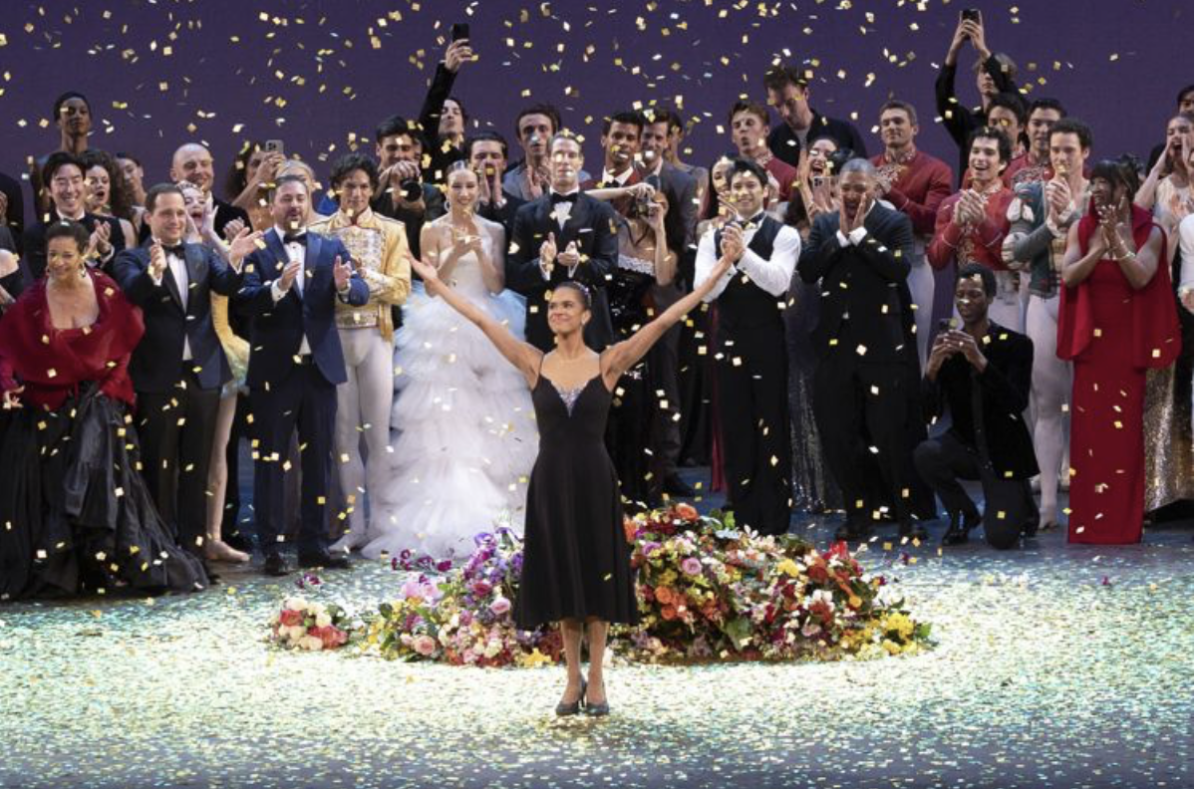
On October 22, 2025, Misty Copeland took her final bow with American Ballet Theatre (ABT) at the David H Koch Theater at Lincoln Center. The performance was part of ABT’s Fall Gala, a one night program built around her return to the stage after five years away. The audience filled the theater, and many more watched a simulcast at Alice Tully Hall. Copeland danced excerpts from Romeo and Juliet, a new work by Kyle Abraham, and Twyla Tharp’s Sinatra Suite. The program marked the end of more than twenty years with the company and brought her performing career to a close.
Copeland’s final bow was the end of a long journey that began far from the traditional path into ballet. She grew up in a financially unstable home and did not start dancing until her early teens. Ballet became a source of structure and stability, and it offered her a sense of direction that she had not experienced before. When she entered American Ballet Theatre, she often found herself as the only Black dancer in the room. This shaped her understanding of the art form and the responsibility she carried as she advanced.
Her rise through ABT exposed how little racial diversity existed in classical ballet. In 2015, she became the first Black female principal dancer in the company’s history. This moment changed how audiences and institutions imagined who could lead major roles. For many young dancers of color, Copeland became proof that they belonged in spaces that had long excluded them. Her presence challenged the idea that ballet’s central figures had to look a certain way or come from a certain background.
Her experience also revealed how deeply ballet’s traditions were built around white dancers. Pointe shoes, for example, were produced almost exclusively in a pale pink shade known as European Pink. Dancers of color had to “pancake” their shoes with makeup to match their skin tone. The process was time consuming and highlighted the fact that the industry did not consider their bodies as part of the norm. Copeland’s pancaked shoes are now held in the Smithsonian’s National Museum of American History as symbols of both exclusion and change.
In recent years, Copeland has pushed for dancewear companies to create pointe shoes in a wider range of skin tones. She has spoken publicly about the need for dancers to feel fully seen onstage without having to alter their shoes. Her advocacy helped expand the conversation about how materials, aesthetics, and identity intersect in ballet. It also showed that change can begin with something as small as the color of a shoe.
Copeland’s legacy extends beyond representation. With her appointment to ABT’s board of trustees, she has moved from being a symbol of progress to someone who can influence policy. She has said that one of her main goals is to increase the number of teachers of color in the company’s school. She understands that the future of ballet depends on who receives training and support from the beginning. Her foundation and production work also allow her to shape how dance is taught and shared with the public.
Taken together, Copeland’s final bow, her rise from an unlikely beginning, and her ongoing advocacy form a clear and powerful arc. She has changed how ballet looks, who it includes, and how it understands itself. The gala at Lincoln Center marked the end of her time onstage, but it did not mark the end of her influence. Instead, it showed how her work will continue in the structures that shape the next generation of dancers.